
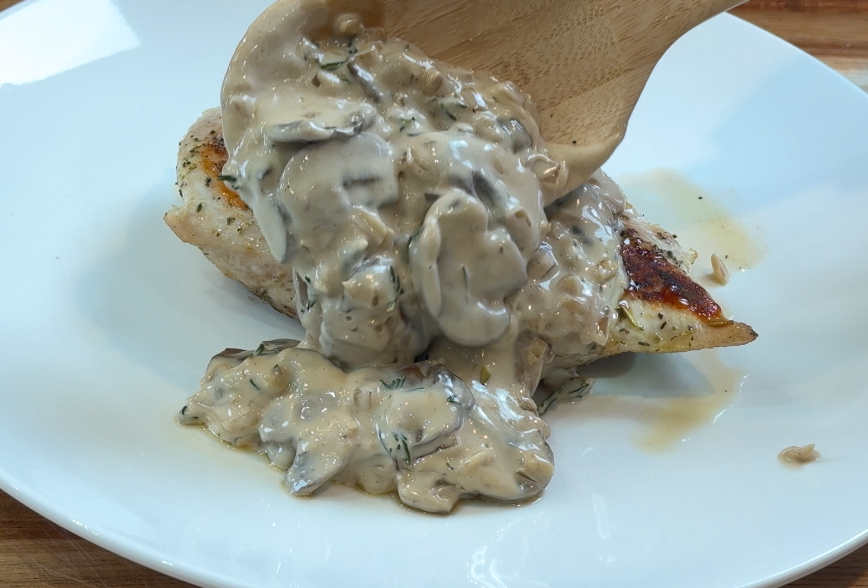
A foolproof method for golden, flavorful mushrooms — and a sauce that finally tastes like a restaurant
Your mushroom sauce has two problems. The mushrooms are spongy and rubbery, and the sauce itself tastes like nothing. Most people think these are two different problems with two different fixes. They’re not. They’re the same problem with one cause — and one technique fixes both. The catch? It’s going to look completely wrong.
Why your mushroom sauce fails (it’s thermodynamics, not skill)
Mushrooms are about 90% water by weight. That single fact is the entire story of mushroom cookery — and the reason most home cooks end up with sad, waterlogged mushrooms swimming in a bland cream sauce.
Here’s what happens in a typical recipe: you heat butter in a pan, add mushrooms, and within seconds, they release a flood of water. The pan is crowded, the water can’t evaporate fast enough, and instead of browning, the mushrooms boil in their own juice. They stay swollen and rubbery. And all that flavorless water dumps into your cream the moment you pour it in, diluting the sauce before you’ve even had a chance to start building flavor.
This is where the science matters. Free water in a pan can’t get above 212°F (100°C) until it’s completely evaporated. Browning — the Maillard reaction, where amino acids and sugars combine under heat to create hundreds of new flavor compounds — needs roughly 300°F (150°C). So as long as standing water is in the pan, you physically cannot brown anything. It’s not a skill issue. It’s thermodynamics.
That browning is where mushroom flavor actually comes from. Skip it, and you skip the entire reason mushrooms taste like mushrooms. The two problems — spongy texture and bland sauce — aren’t separate failures. They’re both what happens when the water doesn’t leave.
The fix: cook your mushrooms in water first
Here’s the technique, popularized by food writer Kenji López-Alt: put your mushrooms in a cold, dry pan with no fat, pour in a quarter cup of water, and crank the heat to high.
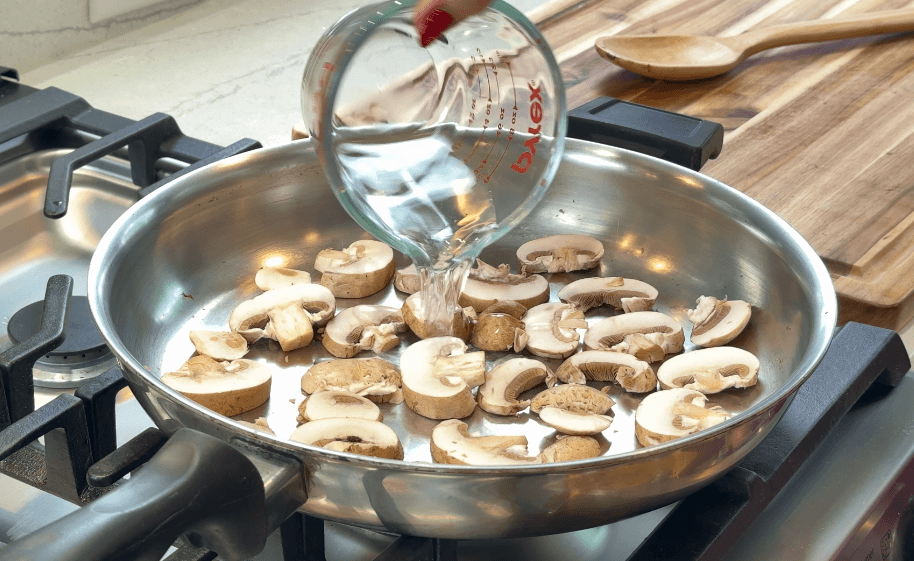
I know. It looks wrong. Trust the process.
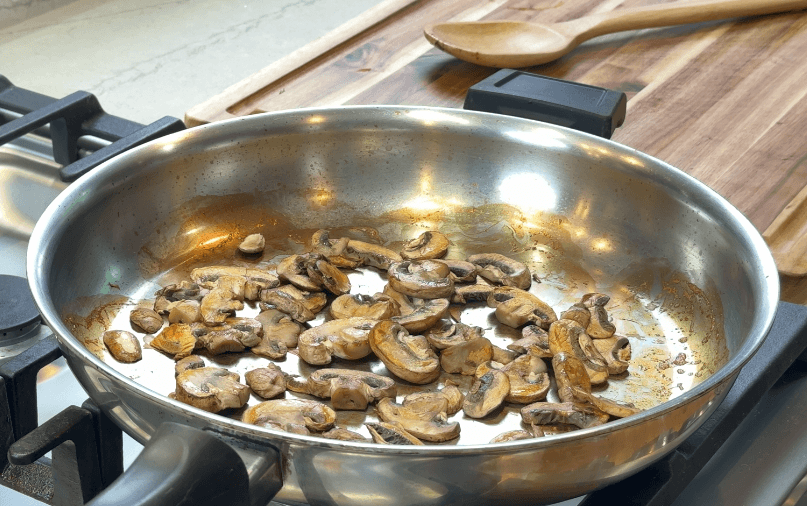
Water transfers heat far more efficiently than oil — roughly 23 times more efficiently, in fact. So when you start with water in the pan, the mushrooms heat up evenly and rapidly. Their cell walls collapse, the internal water gets forced out, and because the pan is on high heat, the water boils off in two or three minutes. By the time the pan goes dry, your mushrooms are already collapsed, concentrated, and ready to brown — and they haven’t soaked up a single drop of fat yet.
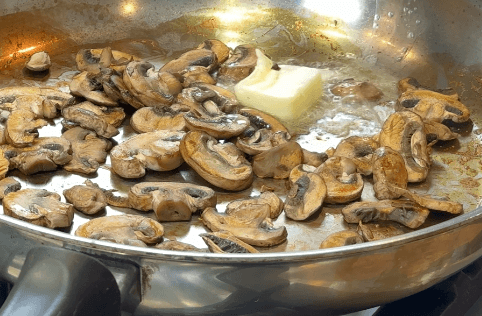
Now you add the butter. The pan is hot, the mushrooms are dry, and the butter does exactly one job: it provides the fat needed for the Maillard reaction to happen. You’ll hear it the moment butter hits the pan — a sharp, urgent sizzle that means real browning is finally underway.
This is the technique that fixes everything downstream. Dry mushrooms mean real browning. Real browning means real flavor. And no excess water means a cream sauce that actually tastes like cream and mushrooms instead of dishwater.
Ingredient notes (and why each one matters)
Every ingredient in this sauce earns its spot for a specific reason. Here’s what each one is doing and why substitutions don’t always work.
Mushrooms. Cremini (also sold as baby bella) or white button mushrooms both work. Cremini have slightly more depth. Slice them about ¼-inch thick — too thin, and they disappear; too thick, and they take longer to collapse
Heavy cream — at least 36% fat. This is non-negotiable. Milk and half-and-half don’t have enough fat to stay stable when reduced, and the acid from the lemon juice is added. They’ll curdle. Heavy cream’s fat content is what holds the sauce together.
Dijon mustard. Half a teaspoon adds a low background tang you won’t taste as “mustard” — you’ll just taste the sauce as “seasoned.” It’s worth being precise about what it’s doing: mustard is a genuine emulsifier in a cold vinaigrette, but in a hot cream sauce that’s not its role — the fat in the heavy cream is what holds everything together. Here, the Dijon earns its place on flavor and balance, rounding out the richness so the sauce tastes finished instead of flat.
Fresh thyme, added early. Thyme’s flavor compounds are fat-soluble — meaning they need to dissolve into hot butter to release. Adding fresh thyme at the end can give you a grassy flavor. Adding it now gives you the warm, woodsy note you taste in restaurant sauces.
Dry white wine for the deglaze. That brown crust on the bottom of the pan after browning is called fond — pure concentrated mushroom flavor. The wine’s acid and alcohol dissolve it and lift it back into the sauce. If you don’t drink wine, vegetable or chicken broth works as a substitute, though you’ll lose a little of the brightness.
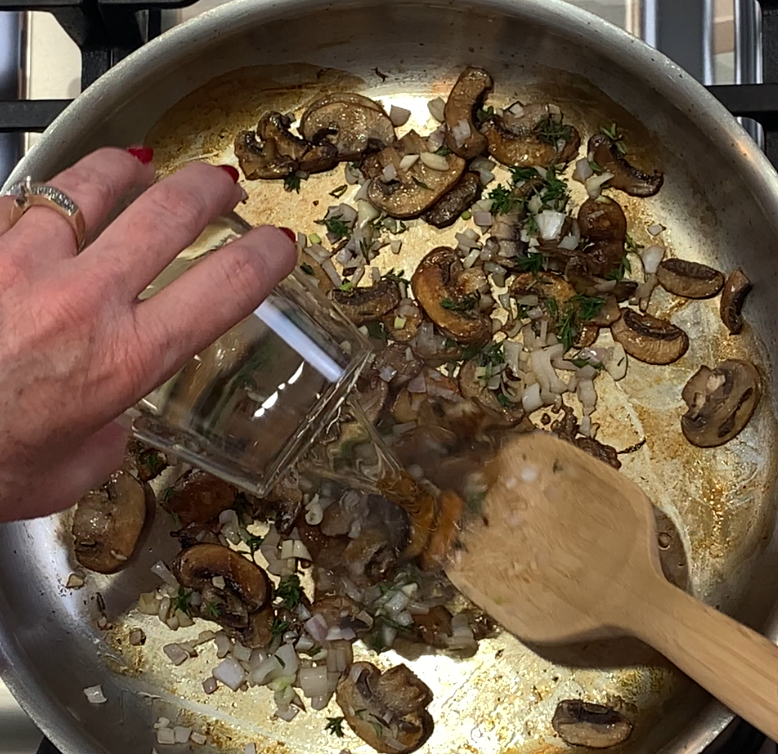
Fresh lemon juice at the end. Cream sauces taste flat without acid — and not because they need to taste lemony. Fat physically dulls your taste receptors on your tongue by coating them. A small hit of acid cuts through the fat and lets every other flavor in the sauce read louder. Think of the lemon as a volume knob, not a flavor.
Mushroom Cream Sauce
Ingredients
Method
- Slice the mushrooms about ¼-inch thick. Add them to a cold, dry pan with the water. Place over high heat.
- Cook for 2–3 minutes, stirring occasionally, until the water has evaporated and the mushrooms have collapsed. The pan should now be completely dry.
- Add the butter to the dry pan with the collapsed mushrooms. The butter will sizzle immediately — that's the start of the Maillard reaction. Continue cooking, stirring occasionally, until the mushrooms are deeply golden brown, about 3–4 minutes.
- Add the minced shallot, garlic, and fresh thyme leaves. Cook for 1 minute, until fragrant.
- Pour in the white wine to deglaze the pan. Scrape the bottom of the pan with a wooden spoon to lift the fond (the browned bits). Let the wine reduce by half, about 1 minute.
- Reduce heat to medium-low. Add the heavy cream and Dijon mustard. Stir to combine and let the sauce simmer gently for 3–5 minutes, until it thickens enough to coat the back of a spoon (nappe consistency).
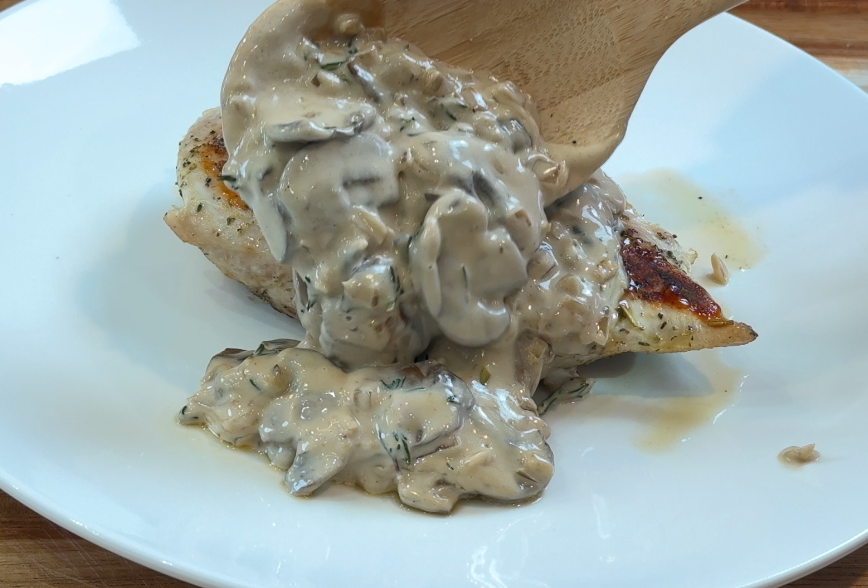
- Remove the pan from the heat. Add a squeeze of fresh lemon juice and season with salt and pepper to taste. Stir gently and serve immediately over chicken, pasta, steak, or polenta.
Video
Notes
Frequently asked questions
Can I use milk or half-and-half instead of heavy cream?
No. Both will curdle when reduced and combined with acid (the lemon and wine). The minimum fat content for a stable cream sauce is 36%, which means heavy cream or heavy whipping cream. If you need a lighter version, a small amount of cream finished with broth is more reliable than substituting milk.
What mushrooms work best?
Cremini (baby bella) and white button mushrooms are the standard, and what this recipe is designed for. Shiitake or oyster mushrooms can work, but will release water differently and may require small adjustments. Wild mushrooms like chanterelles are typically prepared differently and aren’t a 1-to-1 swap.
Can I make this sauce ahead of time?
Cream sauces are best fresh — they can break or separate when reheated. If you need to make ahead, prepare through the browning stage (mushrooms with shallot, garlic, and thyme), then refrigerate. Finish the sauce with cream, mustard, and lemon just before serving.
Why is my sauce still breaking?
Three usual culprits: heat too high when adding the lemon (always add acid off the heat), cream that wasn’t full-fat enough, or reducing the sauce too aggressively after the cream goes in. If a sauce starts to break, pulling it off the heat and whisking in a tablespoon of cold cream often brings it back.
What should I serve this with?
Anything that benefits from a rich, savory sauce: pan-seared chicken breast, pork chops, steak, gnocchi, or wide pasta like pappardelle. It’s also excellent over polenta or roasted vegetables.
More from the science of sauces series
This is Episode 3 in an ongoing series on the science behind classic sauces. Each post tackles one specific failure mode and the technique that fixes it — so the next time you cook, you’ll know exactly why it works.
Episode 1: Never Split a Cream Sauce Again — The Cream Sauce Formula
The foundation of every cream sauce in this series. Why heavy cream curdles, what Dijon actually adds, and the formula that works every time.
Episode 2: Garlic Parmesan Cream Sauce
The same cream-sauce technique is applied to a classic comfort food. Why pre-grated Parmesan ruins the texture, and how to build garlic flavor without burning it.
For new episodes, the moment they go live, subscribe to Cream and Cloves on YouTube — that’s where every recipe in this series starts as a video.
Most home cooking problems have a real explanation — usually rooted in a single principle you can apply across dozens of dishes. That’s what Cream and Cloves is built around. If this post helped you understand why your sauces fail (and how to fix them), subscribe on YouTube for new episodes and follow along here for the written companion recipes.